

Most businesses that are overspending on printing don’t know it, and there’s a simple reason why. The cost never shows up as one obvious number. It’s spread thin across toner purchases, service calls, IT time and a dozen small invoices, which makes it genuinely easy to miss even when the total is significant.
Industry research from IDC suggests print can consume up to 3% of a company’s annual revenue, yet nearly half of businesses have little real insight into where that spend actually goes. Rather than a single red flag, overspending usually shows up as a collection of smaller, recognisable signs. Here’s what to check for, and what to actually do about it.
The signs worth checking for
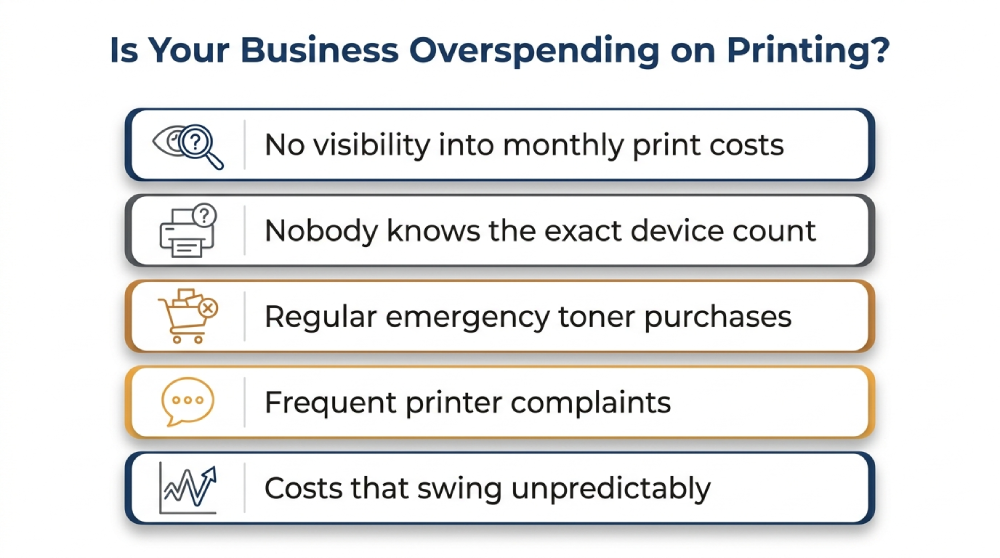
You can’t quickly answer what you spend on printing each month. This is the single most telling sign. If the true monthly cost, toner, paper, maintenance, leases, the lot, isn’t something anyone in the business could state with confidence, it’s very likely higher than anyone assumes.
Nobody can say exactly how many printers or devices the business actually owns. Fleets grow quietly over years, through office moves, new hires, departmental purchases and the occasional forgotten device in a back room. If a straightforward count isn’t easy to produce, the fleet has likely outgrown anyone’s active management.
You’re regularly making emergency toner purchases. Running out unexpectedly and buying replacement cartridges at retail prices, often at a premium for same-day availability, is one of the clearest and most avoidable cost leaks in a business.
Some devices are constantly busy while others barely get touched. An uneven fleet, printers clustered in one area and underused elsewhere, still costs money in supplies, servicing and floor space regardless of how little they’re used.
Staff regularly complain about jams, slow printing, or a printer being down. Every one of these moments costs real, if invisible, staff time. When “the printer’s broken again” becomes a familiar office phrase, that frustration has a genuine dollar figure behind it.
Your IT team spends real time on printer troubleshooting. Industry research has estimated printer-related issues can account for as much as 17% of IT help desk calls, time that could otherwise go toward higher-value work.
Printing costs swing unpredictably month to month. Without a managed structure, costs are reactive rather than planned, which makes budgeting genuinely difficult and often masks a rising trend until it’s substantial.
A meaningful share of what gets printed is never even collected. Research suggests around 20% of printed documents go unused entirely, printed and left in the tray, a surprisingly direct and avoidable cost.
Sensitive documents sit unclaimed in output trays. Beyond the wasted cost, this is a genuine security gap, particularly for businesses handling payroll, financial, legal or client information, where a print left unattended is a real exposure, not just an inefficiency.
Why this happens in the first place
None of this usually happens through one bad decision. Print costs are unusual in how easily they hide: no single invoice looks alarming, the fleet grows one device at a time rather than all at once, and because nobody owns the problem specifically, it’s rarely reviewed. By the time the pattern is visible, it’s often been building for years.
How to actually fix it
The fix mirrors the signs directly, and it starts with visibility rather than assumptions.
Get real usage and cost data. You can’t reduce what you can’t see. A proper print assessment reviews your actual devices, volumes and current spend, replacing guesswork with an accurate baseline.
Right-size the fleet. Consolidating underused devices and placing the right machine in the right location, rather than an oversized one where it isn’t needed, removes cost without disrupting how people actually work.
Automate supplies. Toner that reorders automatically before you run out eliminates emergency purchases and the retail premium that comes with them entirely.
Move to proactive maintenance. Devices monitored and serviced before they fail reduce the downtime and IT time that come with reactive, “call when it breaks” support.
Add secure print release. Where confidentiality matters, requiring authentication before a job prints resolves the output-tray risk and cuts down on documents printed but never collected.
This is essentially the process a properly run managed print service is built around, which we’ve covered in full in our guide to what managed print services actually is and how it works. If you’re also weighing up whether outsourcing makes financial sense for your specific situation, our comparison of DIY versus managed print costs goes into that side of the decision in more depth.
Frequently asked questions
How do I know if my business is spending too much on printing?
Look for a cluster of recognisable signs rather than one obvious red flag: not knowing your monthly print spend, not knowing exactly how many devices you have, regular emergency toner purchases, frequent printer complaints, unpredictable monthly costs, and printed documents that are never collected. If several of these sound familiar, your business is very likely overspending without realising it.
What’s the biggest sign of print overspending?
Not being able to quickly state what your business actually spends on printing each month. Because print costs are spread across many small purchases and invoices rather than one line item, this lack of visibility is usually both the clearest sign of overspending and the root cause of it continuing.
How much does the average business overspend on printing?
It varies, but industry research suggests print can consume up to 3% of a company’s total revenue, and nearly half of businesses have limited insight into where that cost actually comes from. Without visibility, meaningful overspending can continue for years without being noticed.
Is buying emergency toner really that costly?
Yes, more than most businesses realise. Running out unexpectedly and buying at retail prices, sometimes with a premium for urgency, is one of the most avoidable costs in printing, and it’s also one of the clearest signs that supply ordering isn’t being managed proactively.
What should I do first if I recognise several of these signs?
Start with a proper print assessment rather than guessing at fixes. Understanding your actual current devices, volumes and costs gives you a genuine baseline to work from, and usually reveals exactly where the biggest, most fixable costs are sitting.
Does fixing printing overspending require replacing all our equipment?
Not necessarily. A right-sizing review often means consolidating or relocating existing devices rather than replacing an entire fleet. The goal is matching your equipment to how your business actually prints, which sometimes means less equipment, not different equipment.
Find out where your business actually stands
If several of these signs sound familiar, the most useful next step is a clear, accurate picture of your current print environment rather than another guess.
QPC Group offers a free print assessment: we review your current devices, volumes and real costs, then show you exactly where the overspending is happening and what a right-sized setup would look like. Get in touch with QPC Group or call our team on (08) 9303 3888.
This article provides general information to help identify potential print cost inefficiencies. Actual costs and savings vary by business, fleet size and usage.