

On paper, managing your own printers looks like the cheaper option. You buy the hardware, you buy toner when it runs low, and that’s the budget line, done. Managed print, by comparison, looks like an extra monthly cost layered on top of something you were already handling yourself.
Once you count everything that actually goes into running printers in-house, not just the hardware and toner, the picture usually looks different. For most small and medium businesses with more than a device or two, the hidden costs of self-managing tip the balance toward outsourcing being genuinely cheaper overall. That’s not universally true, and this guide walks through the full comparison honestly, including where DIY can still make sense, so you can work out which side of the line your business actually falls on.
What DIY printing actually costs, once you count everything
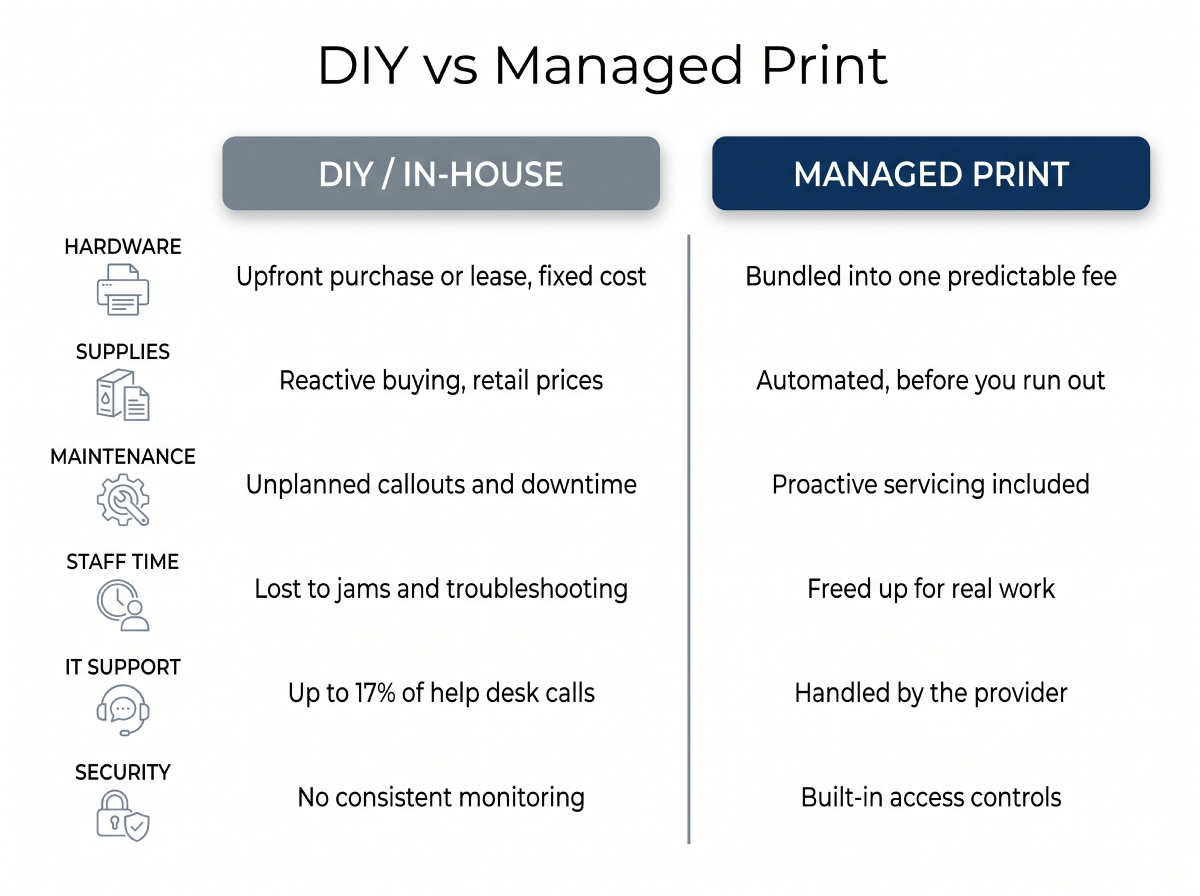
The visible costs of managing your own printers are straightforward: the hardware and the toner. The costs that actually determine whether DIY is cheap or expensive are almost all invisible until you go looking for them.
Hardware and depreciation. A printer or copier costs money whether it’s sitting idle or running flat out, and that capital cost, or lease payment if you’re financing it, exists regardless of how much you actually use the device.
Consumables, done inefficiently. Buying toner reactively, waiting until you’re out before ordering, tends to mean paying retail prices or rush shipping rather than a planned, bulk rate. Decentralised purchasing across departments compounds this, with different people buying different cartridges at different prices with no coordination.
Energy. Older, less efficient printers can use meaningfully more electricity than modern equipment, and across a fleet of several devices, this adds up as a real, ongoing cost that rarely gets attributed back to “the cost of printing” in most budgets.
Maintenance and downtime. Printers break. It’s a question of when, not if, and every service call costs both the callout itself and the lost time waiting for it to be resolved. Multiply that across a fleet, and unplanned maintenance becomes a recurring, unbudgeted expense.
Staff and IT time. This is usually the single biggest hidden cost, and the easiest to miss because it never appears as a line item. Employees lose real, paid time to jams, driver issues, hunting for an available printer, and waiting on slow jobs. Gartner research, widely cited across the industry, estimates that printer-related issues account for as much as 17 percent of IT help desk calls, which means your IT time, whether that’s an internal team or an external provider, is being consumed by printer troubleshooting instead of higher-value work.
Security exposure. Networked printers are a genuine, documented point of vulnerability, and an unmanaged fleet typically has no consistent access controls, secure print release, or monitoring in place. This is a cost that doesn’t show up until something goes wrong, at which point it can be a very large one.
Fleet inefficiency. Self-managed environments tend to accumulate the wrong devices in the wrong places over time, an expensive, high-capacity machine sitting in a low-volume corner of the office, while a busier area makes do with something underpowered. Nobody planned it that way; it just happened gradually, and it quietly wastes money the whole time.
What managed print costs, in comparison
Managed print rolls all of the above, hardware, supplies, maintenance, support and monitoring, into one predictable service, typically priced per page, per device or per user. We’ve covered exactly how that pricing works and what typical Australian rates look like in our guide to managed print services costs, so rather than repeat it here, the short version is this: instead of a scattered set of unpredictable expenses across the categories above, you get one line item, and the categories that were previously invisible, staff time, IT burden, downtime, fleet inefficiency, are actively managed down rather than left to accumulate.
So which one actually costs less?
Here’s the honest answer: for most businesses running more than a device or two with genuine day-to-day printing needs, managed print typically works out cheaper once the full picture is counted, not because the per-page rate is dramatically lower, but because the hidden categories, staff time, IT support, downtime, inefficient fleet, are the ones actually driving the real total. Industry estimates on the resulting savings vary, but reductions in total print costs somewhere in the range of 10 to 30 percent are commonly cited once a business moves from unmanaged, ad hoc printing to a properly managed setup.
That said, it’s a genuine comparison, not a foregone conclusion, and DIY can still make sense in some situations. A very small business with a single, low-volume printer and no complex needs may find the hidden-cost categories above simply don’t add up to much, since most of them scale with the number of devices and the volume running through them. The tipping point tends to be reached once a business has multiple devices, meaningful print volume, or staff and IT time being consumed by printer issues rather than actual work. If that describes your business, the case for outsourcing is usually strong. If it doesn’t yet, DIY may still be the practical choice, at least for now.
How to find out where your business sits
The only reliable way to know which side of that line you’re on is to look at your actual numbers rather than guess. A print assessment reviews your current devices, volumes and the real costs behind them, hardware, consumables, service history, and gives you a genuine comparison rather than a generic industry estimate.
Frequently asked questions
Is it cheaper to buy your own printers or use a managed print service?
It depends on your business size and printing needs, but for most businesses running multiple devices with regular volume, managed print typically works out cheaper once hidden costs are counted, including staff time lost to printer issues, IT support burden, downtime, inefficient device placement, and reactive supply purchasing. A very small operation with light, simple printing needs may still find self-managing perfectly workable.
What hidden costs come with managing your own printers?
The biggest hidden costs are usually staff and IT time lost to jams, troubleshooting and hunting for available devices, unplanned maintenance and downtime, inefficient or reactive toner purchasing, energy use from older equipment, security exposure from an unmanaged network of devices, and a fleet that’s gradually become mismatched to actual usage. None of these show up as a single obvious expense, which is exactly why they’re so often missed.
How much can a business save by switching to managed print?
Savings vary by business and current setup, but industry estimates commonly cite total print cost reductions in the region of 10 to 30 percent after moving from an unmanaged environment to a properly managed one. Much of that comes from visibility, knowing what’s actually being printed and where waste is occurring, rather than simply a lower per-page rate.
When does it make sense to keep managing printers in-house?
DIY can still make sense for very small businesses with a single low-volume device and straightforward needs, since most of the hidden costs that make outsourcing worthwhile scale with the number of devices and the volume printed. If your printing needs are genuinely light and simple, the overhead of a managed agreement may not be justified yet.
Does IT support time really cost that much when managing printers ourselves?
It adds up more than most businesses expect. Industry research widely cites printer-related issues as accounting for up to 17 percent of IT help desk calls, which means real, paid staff time is being spent on printer troubleshooting rather than other work. For a business with limited or outsourced IT resources, that time carries a genuine cost even though it rarely appears as a specific line item.
Get a clear answer for your business
Rather than guessing which side of the comparison your business falls on, the most useful next step is to actually look at the numbers.
QPC Group offers a free print assessment: we review your current devices, volumes and real costs, then give you a straightforward comparison so you can see exactly where DIY and managed print stack up for your specific setup, with transparent pricing and local Australian support either way. Get in touch with QPC Group or call our team on (08) 9303 3888.
This article provides general information to help compare in-house and managed print options. Actual costs and savings vary by business, fleet size and usage. Speak to a managed print provider for figures specific to your organisation.